

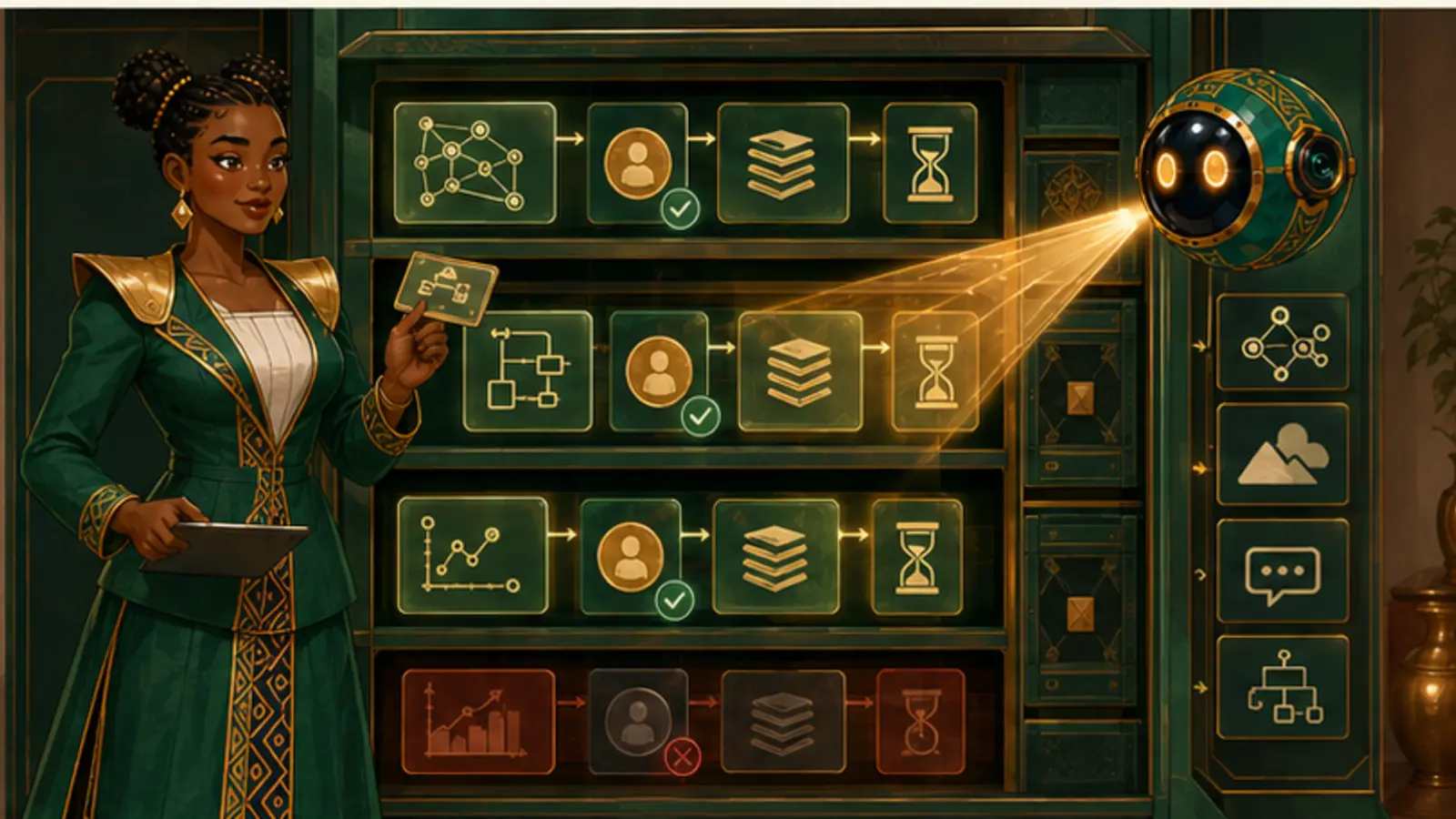
A prompt worth keeping needs a card: purpose, inputs, what good looks like, the human check, and when to review it.
Do now: Take one prompt that worked and write its card.
An undated prompt library becomes folklore within a year.A prompt library is the difference between a person who is good at AI and a team that is. It also protects quality: retyping from memory produces different results on different days, and nobody can tell you why.
What a library card contains
Purpose in one sentence: what job this does and for whom. If you cannot write it, the prompt is probably doing three things and should be three prompts.
Required inputs, and explicitly which must never contain personal or confidential data. This is where the privacy decision gets made once for everyone who will ever use the card, rather than in a hurry by each of them.
What good output looks like, concretely enough that a colleague could judge it. Then the human check that must follow, named specifically. Then known failure modes — the things this prompt gets wrong when the input is unusual.
Finally an owner and a review date. Prompts go stale as tools change and as the work changes, and without a date nobody ever notices.
If the purpose does not fit in one sentence, it is three prompts pretending to be one.
Write prompts other people can run
Use explicit placeholders — [AUDIENCE], [DOCUMENT], [DEADLINE] — so it is obvious what must be supplied. A prompt full of unstated assumptions works only for the person who wrote it, and only while they remember them.
Include the constraints in the prompt rather than in your head: what must not be invented, what format is required, what length, what must not be promised. Anything you rely on the model 'knowing' will vary.
Test it with someone else's input. The moment a colleague runs your prompt on their own material, every hidden assumption becomes visible, and that is a fifteen-minute test that saves months of quiet inconsistency.
Maintain it, and retire things
Version the cards. When you change a prompt, note what changed and why, so you can go back when the new version turns out to be worse in a way you did not anticipate.
Retire aggressively. A library of two hundred prompts nobody browses is worse than twelve that are used constantly, because the good ones become unfindable. If a card has not been used in six months, ask whether it should exist.
Watch for cards that encode something now wrong — a superseded policy, a changed platform rule, a price. These are more dangerous than useless cards, because they carry authority from having been in the library.
Twelve prompts people actually use beat two hundred nobody can find.