

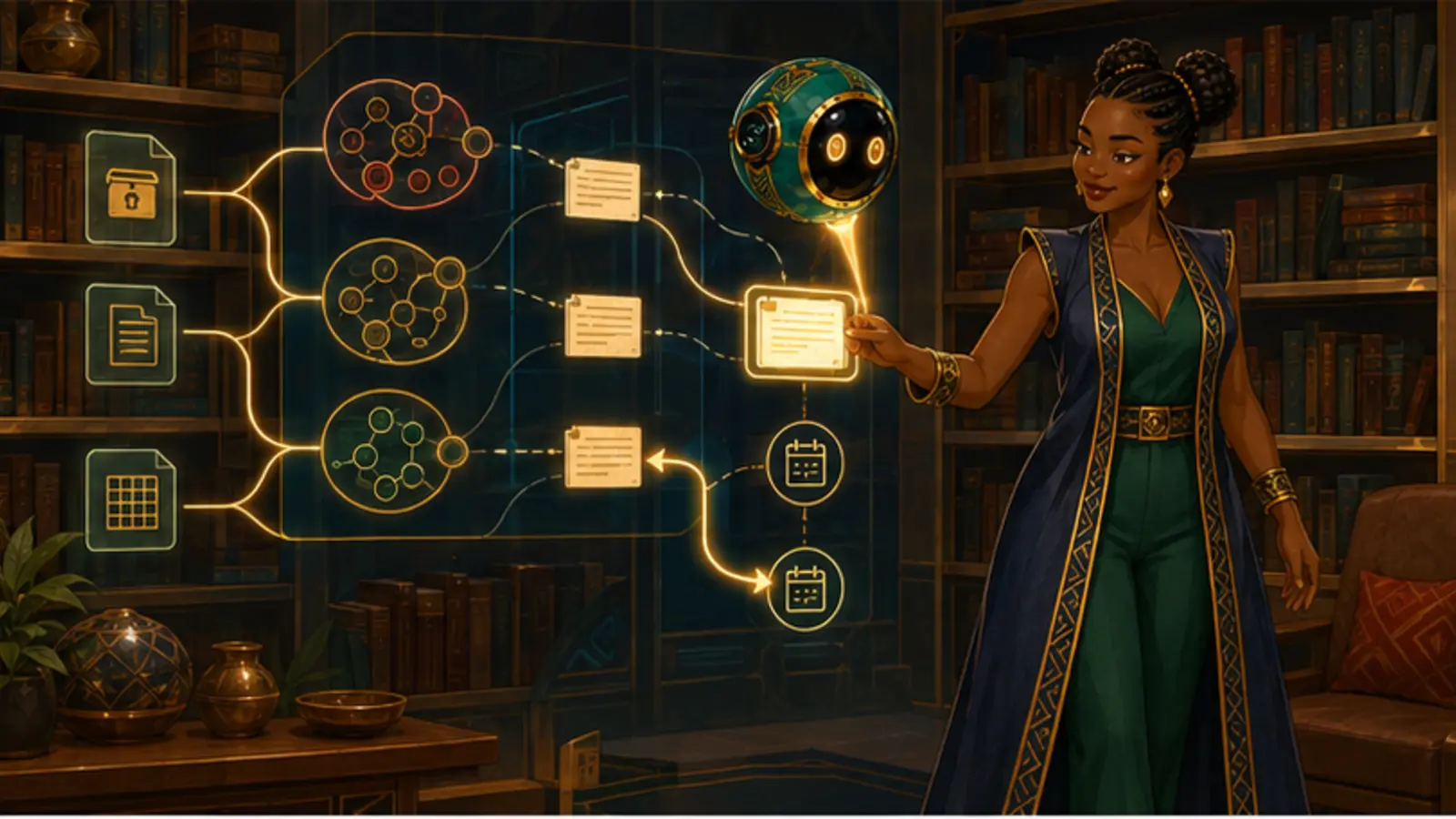
Capture is only useful if retrieval works. Name for how you will search, not for how you feel today.
Do now: Rename three recent files so a stranger could find them by searching.
Write for the person who has forgotten everything. That person is you, in March.Most knowledge is lost not because it was never written down but because it was written somewhere nobody can find, without enough context to be understood later. AI makes producing material faster, which makes this problem larger rather than smaller.
Capture with context, not just content
A saved output without context is nearly useless later. Record four things alongside it: what the task was, when, what was decided, and what remained uncertain. Those four lines take a minute and are the entire difference between a note and an archive.
Record the decision, not only the discussion. Six months later nobody needs the reasoning in full; they need to know what was chosen and by whom. If you keep only one thing, keep that.
Note what you would check if you revisited this — the figure that might have changed, the rule that might have been updated, the assumption that might no longer hold. Your future self will not remember which parts were soft.
Four lines of context turn a saved output into something usable. Without them it is a file you will not open.
Name for search
Use a consistent pattern: date, topic, type. `2026-08-17_supplier-order_workflow` is findable by date, by topic and by kind. `final_v3_actual_FINAL` is findable by nothing, and everyone has a folder full of them.
Put the words you would actually search for into the name and the first line. People search for what a thing is about, not what it was called in the meeting where it was created.
Keep the number of locations small. One place for work in progress, one for finished material, one for reference. Elaborate folder structures fail because they require a decision every time you save something, and under pressure people skip the decision and save to the desktop.
Retrieval is the test
Test the system, do not just build it. Once a month, try to find something from three months ago. If you cannot in two minutes, the system is not working, and no amount of adding structure will fix a naming problem.
Be careful with AI-generated summaries as your only record. A summary of a summary drifts, and after two generations you have something confidently unlike the original. Keep the source alongside anything summarised.
For shared knowledge, name an owner and a review date. A team knowledge base with no owner accumulates contradictions — three answers to the same question, all plausible, none dated — and people stop trusting it, which is worse than not having one.
If you cannot find a three-month-old item in two minutes, the system has already failed.