

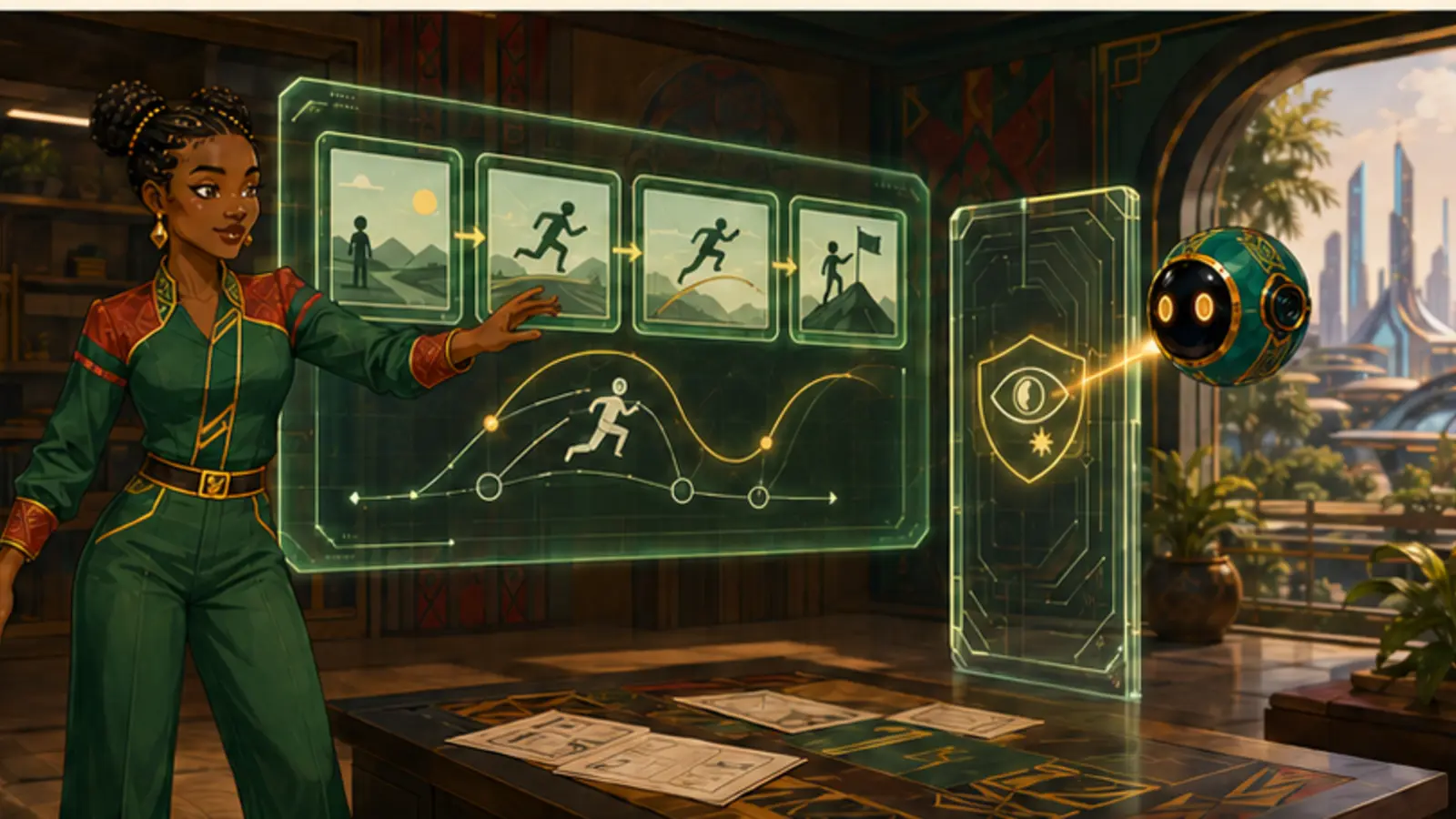
AI helps video in four places: planning, generating footage, editing, and captioning. Only generation raises authenticity questions.
Do now: Plan a six-shot sequence and mark which shots must be real.
Decide what must be true before you decide what looks good.Video is the most persuasive medium most people will ever publish in, and persuasion carries responsibility. Planning before generating also saves the most money, because video is the most expensive thing to redo.
Four different jobs inside 'AI video'
Planning: turning a script into shots, angles and a running order. This is text work applied to video, it is low-risk, and it is where most of the time is saved.
Generation: creating footage that was never filmed. Quality has improved enormously and so has the ability to mislead. Editing: cutting, reframing, colour, and increasingly assembling rough cuts from footage you shot. Captioning and translation: the highest-value, lowest-risk category, and the most neglected.
Most real productions use three of the four and generate nothing. That is a perfectly good outcome — 'AI video' does not have to mean synthetic footage.
The cheapest AI win in video is captions. The riskiest is generated footage. They are not the same decision.
Plan first, because video punishes improvisation
Work at the shot level: what is on screen, how long, what it needs to communicate, and where it comes from. Six well-planned shots beat sixty improvised seconds, and the plan tells you what to film before you are standing somewhere without the right light.
For each shot, mark the source: filmed, archive, licensed, generated. Do this in the plan, not afterwards, because reconstructing it during the edit is where records get lost and rights get assumed.
The plan is also where you notice the shot you cannot get. Better to discover that at a desk than on location.
Authenticity, disclosure and the viewer's assumption
The question is what a viewer would reasonably believe. Obviously stylised animation claims nothing. Photorealistic footage of a place, an event or a person claims those things happened and looked like that. If the footage is generated and a viewer would assume otherwise, disclose it.
Platforms have their own requirements for labelling realistic synthetic content, and those requirements change. Check the current rules for each platform you publish on rather than relying on what was true last year.
News, safety, health and anything involving real named people deserve a higher bar. In those contexts, generated footage of events is not a stylistic choice; it is a claim that something happened.
If a viewer could reasonably think it was filmed, and it was not, say so.